Showing posts with label Kiss. Show all posts

Thursday, December 3, 2015

You Really Got Me Now

If the Beatles' crucible were the rough-and-tumble clubs of Hamburg, Germany, Van Halen's were poolside backyards in sunny Pasadena. Greg Renoff's new book VAN HALEN RISING puts the reader in the crowds of teens paying $1 admission for illicit outdoor keg parties where an ascending Van Halen provided the entertainment, and forged its spirit.

An immersive, well-researched tale of pre-fame trajectory, VAN HALEN RISING also makes a convincing case for how revolutionary they were upon arrival — a conceit that's easy to overlook beyond the considerable chops of Eddie.

The Van Halen family arrived in California as Dutch immigrants in 1962 with little more than a piano to their name. Father Jan worked as a jazz clarinetist in Europe and followed relatives and a vague promise of opportunity to California, settling in working-class digs in suburban Pasadena.

His two sons, who didn't even speak English when they arrived, dutifully took piano and violin lessons until their restlessness for experimentation became too great and they morphed into aspiring rockers. Drummer Alex and guitarist Edward fronted a variety of cover bands playing under names like the Broken Combs, Trojan Rubber Company, Genesis, and Mammoth. The latter two names would be retired upon learning that other bands went by the same handles: The eponymous surname they eventually settled upon, Renoff reveals, came not from them but from an influential new frontman.

The Van Halens and David Lee Roth first came across one another as musical rivals, and they could not have been any more different. The son of a wealthy ophthamologist, Roth pursued stardom as obsessively as Eddie pursued guitar. Drawn to what he recognized were the area's best musicians, Roth auditioned to sing for them only to be rejected — twice. Undeterred, Roth eventually wormed his way into Mammoth against the better judgement of its existing members, in part by relieving Eddie of unwanted lead vocal duties, but mainly by possessing a PA system they needed to gig. Using the PA as leverage, Roth would at times loan the equipment in exchange for a chance to sing and others just as an excuse to hang around. When they could no longer stand to be in Roth's debt, they surrendered and made him the singer. Renoff calls this "the greatest rock and roll power play of all time."

Then a cover band noted for their ability to deliver note-for-note renditions of heavy rock classics, Mammoth were an odd fit for Roth, whose influences included cheeseball crooners like Louis Prima and whose tastes leaned toward Motown, glam and funk. Beyond that, he wasn't anyone's idea of a good singer. But his influence was a crucial ingredient in the Van Halen formula, Renoff notes. He got the band to lighten up on plodding, blues-rock jams and aim instead toward tight, melodic rock you could dance to. He convinced them to cover songs like Billy Preston's "Will it Go Round in Circles." He also injected the band with a sense of style, encouraging his bandmates to adopt flashy stage clothes instead of the jeans and flannel shirts they typically wore.

This new approach also required the band improve their singing, leading to the addition of bassist Michael Anthony. Anthony, whose soaring background vocals would become another distinct element of the Van Halen sound, proved to be "the final piece of the puzzle," Renoff writes.

As Van Halen graduated from backyard jams to club dates it had several brushes with success — most notably a doomed come-on from KISS' Gene Simmons who not surprisingly had per$onal goals in mind. But in a time when metal was dying, disco was soaring, punk was coming, and California was still exporting soft-rockers, the notion of breaking a heavy rock act was considered a longshot by the industry, and several labels passed.

In the end, talent won out. Ted Templeman, a house producer for Warner Brothers whose clients included both heavy-guitar acts (Montrose) and three-part harmony singers (the Doobie Brothers) caught them at an LA showcase. "I saw Ed and I was fucking knocked out," Templeman tells Renoff. "He was the best musician I'd ever seen in person."
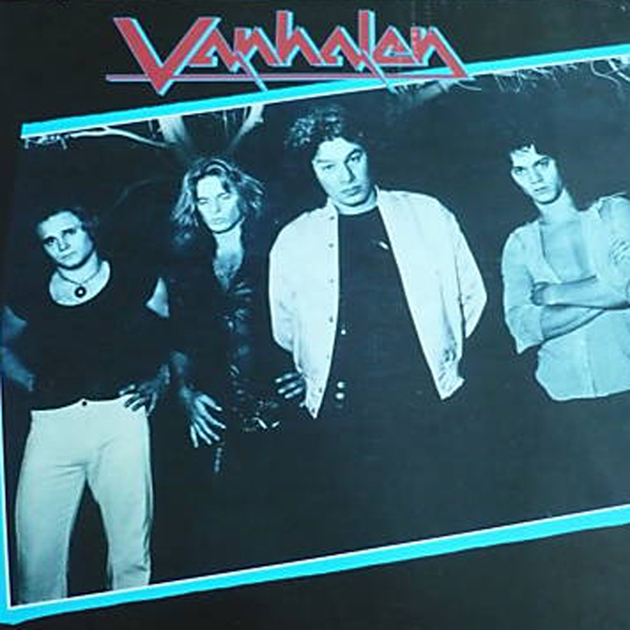
Still, Van Halen was a hard sell: Templeman was careful to present them first to Warners' open-minded president Mo Ostin as opposed to its chief A&R man, Lenny Waronker, at the time a leading advocate of the soft-rock "L.A. sound." And as the label prepared for the release of their first album, members were horrified when an early version of the cover packaged them as though they were a punk band.

Renoff's case for Van Halen as rock revolutionaries was made not only by its fresh sound profile -- hard-hitting riffs with melody and vocal harmonies, accompanying Eddie's stunning virtuosity -- but also by the tours in support of their debut album. Aging metal masters Black Sabbath purposefully selected Van Halen to open a 1978 tour for them with the idea that casting an unknown would keep the fans' focus on them, but the scheme backfired spectacularly as Van Halen shocked one audience after another, while brashly going toe-to-toe with any musicians who'd outparty them. The tour so demoralized Black Sabbath that singer Ozzy Osbourne would soon set off on his own, and as the record took off -- peaking at No. 19 on the Billboard charts, but destined to stay in the top 200 for 169 straight weeks -- hard rock was the never the same.

Renoff ascribes the subsequent success of platters like AC/DC's BACK IN BLACK, the Scorpions' LOVE AT FIRST BITE and Judas Priests' SCREAMING FOR VENGEANCE to the cultural breakthrough of Van Halen. While Van Halen were never a "metal" band per se -- Roth preferred the term "Big Rock" -- they influenced the genre with bands like Priest, KISS and others shamelessly borrowing their best tricks, while a generation of young guitarists had a new hero.

Saturday, March 28, 2015

Shout It Out Loud

For a guy who allegedly hates KISS, I finished my third book on the subject.

I'd learned in the last one I tackled that it was Paul Stanley, and not as I had long assumed, Gene Simmons, who was the real force behind KISS, yet as entertaining as that book was, there was much of the Starchild yet to be revealed. While I'm sure that was to some degree intentional (Paul is the last of the original Kissmen to pen a bio), Paul Stanley would have you believe that taking off the makeup, so to speak, was also quite difficult.

One other thing I guessed wrong: Paul wasn't gay, he was deformed! Turns out he was born with a condition called microtia which left only his left ear fully formed, and his deafness and deformity became the subject of childhood bullying leaving him deeply withdrawn, insecure and distrustful. On top of that, Paul writes, he lacked understanding parents and grew up with a troubled sibling, retreating almost completely behind the Starchild alter ego of his performances.

Teenage Paul sought treatment from a therapist on his own, and in a page out of the Brian Wilson-Eugene Landy playbook years later would hire the guy to manage the band to predictable results. One thing about KISS is, they never learn. Paul discusses one move after another -- personnel changes, management agreements, personal relationships, concept albums and so on -- that explode in his face like a stream of fire from Gene's mouth. And while Paul never really stops seeing himself as a deformed, picked-on, lonely kid -- in fact explaining just about all of his issues on it --  he comes to a good place realizing somewhat late in life (as I have) that his children are why he's here.

Today he describes a life of gourmet home-cooked Italian meals, oil painting, a loving family, and reflection gained from an irony-rich turn playing the lead in a production of Phantom of the Opera. And he's totally OK with the notion that anyone could put on the makeup and continue serving his role as the singer of KISS. In fact he wishes it so, explaining his seeming insensitivity to the fact that the band continues to tour (and rake in the cash) behind impostors in the costumes of Peter and Ace.

This perspective no doubt colors Paul's understanding of the band itself. While he pities Ace's self-destructiveness, and takes Gene to task for his phoniness and self-serving devotion to the KISS cause, he can't manage to even mention Peter without also ripping him a new one. Not only did the KISS drummer's sour demeanor undermine the mission of the band, but, Paul suggests, he's also an idiot and a lousy musician.
"Peter could barely read or spell, and he wasn't a thinker. Peter didn't understand the basics of song structure. Verse, chorus, bridge - it all meant nothing to him." 
"Peter was not what you'd call an intellectual. He seemed to get off on causing problems with the band."
"Peter seemed to resent everything he was given ... as far as I saw it, Peter never succeeded before he hooked up with us because he had no idea what it took to become successful or sustain success. He was along for the ride and couldn't help trying to hamper things and create strife."
 "'Detroit Rock City' in particular had a very challenging drumbeat, and it took a lot of effort and patience for [producer] Bob [Ezrin] to get Peter to play something he couldn't have learned to play on his own if his life depended on it." 
"Peter's chances of being able to sing a song off the cuff were about as good as my chances of throwing a penny and hitting the moon."
Me-ow. And those are but samples. I might have liked a more honest assessment of the music Paul was responsible for -- I've given it all a shot, and can't honestly say it's improved since 1974 -- but as the chronicle of the band's only fully devoted member FACE THE MUSIC is the best solo effort we're going to get from these guys. Rock on, Starchild.

Friday, February 21, 2014

The Hottest Band in the Land

Gene $immons doesn't need to squeeze another penny out of the KISS merchandise vault so I urge you: Do like I did and get the new biography NOTHIN' TO LOSE from your local library, and not from your local or virtual bookstore. I'll be returning my copy to Mid-Manhattan Library at 5th and 41st any day now so there's at least one out there.

The book, credited to Gene, bandmate Paul Stanley, and longtime KISS Kronikler Ken Sharp, is an oral history focusing exclusively on the period between 1972 and 1975 when KISS was formed, signed, released four albums, toured the country, and transformed from complete unknowns to fire-breathing arena superstars. It is a remarkable and absurd American success story.

Back in the 70s, my brother was a Kiss Army soldier, so I was quite familiar with the band, particularly the versions of songs off their first three studio albums whose live versions comprised 1975's careermaking ALIVE! double-set. Strongly influenced by prevailing critical opinions and a need to zig where my brother zagged, I outwardly expressed disdain for it all, even as I found the whole thing psychically and visually intriguing. Musically, I could take or leave them. Paul can be an exciting vocalist, and they had some fun rockin' tunes, but I found the lyrics idiotic even then. Their vision of being a heavier version of the Beatles was better conceptually than ever executed. They were a band for 9-year-olds when I was 11.

I learned some interesting things: Paul and Gene walked away from a record offer from their first band together, Wicked Lester, mainly because they themselves didn't believe in the music or the band's prospects. And they describe how they reached to find musicians to achieve their musical goals, even as it meant gambling on guys who'd prove difficult to work with: The sour and doubt-riddled drummer Peter Criss; and the talented but hard-partying lead guitarist Ace Frehley (whose own autobiography, NO REGRETS, skims over entire years he simply cannot remember). Weird, green, outer-borough Jews they may have been but KISS knew what they wanted. Their naked ambition to make it saw them hauling empty boxes disguised as Marshall amplifiers to shows, shop for costumes and props at pet stores and S&M shops and learn stage tricks from vaudeville magicians. They played local shows infrequently, giving audiences the illusion they were out touring the world while in reality they were incessantly rehearsing in a 23rd Street loft. Carefully manipulated appearances and press (thanks, Gene) helped them leapfrog contemporaries with more experience, bigger fanbases and better chops.

The big idea behind the kabuki makeup and stageshow was to consolidate the gains the band Alice Cooper had made in terms of rock theatrics, but advance them by making each member of the band as distinct as Alice Cooper the singer. It was brilliant (Alice Cooper, as noted in the below post, was just about to recede). And Kiss showed a terrific instinct for image-conscious management: they employed a gay game-show producer, Bill Aucoin, as their manager. Aucoin's lover, Sean Delaney, would take charge of their flamboyant stage show. And when they signed a record contract, it was with bubblegum maven Neil Bogart's upstart Casablanca label, which might have been the only company crazy enough to bankroll KISS through its spectacularly unprofitable early years when they toured like crazy but sold almost nothing and were all but ignored by radio. The music by definition almost always took a backseat. Even fully-realized early KISS classics like "Strutter" tend to be marred by muddy recordings, and the studio albums from this period (KISS and HOTTER THAN HELL from 1974 and DRESSED TO KILL from early 1975) were hasty affairs largely written and performed on the spot between punishing cross-country road trips.

A wealth of interviews with KISS' road crew -- not to mention remarks from bands unfortunate enough to share billing with KISS in those years -- will leave you with little doubt as to KISS' work ethic. Yet the 500-page book still doesn't tell quite enough: Paul Stanley of all people emerges as the most instrumental of KISS's creators: A young, ambitious frontman, graduate of a Manhattan performing arts high school, and a student of English psych-rock groups like the Move. We also get the impression he's a sensitive former fat kid. Of course, he's got his own autobiography in the works, perhaps he addresses the elephant of his sexuality and his other motivations there.

The band-approved bio never strays too far from the company line. While KISS's alleged skill at blowing other bands off the stage is repeated over and over, about the worst thing other quoted musicians have to say about them in the book was that their music was "dumb" or the act was "corny" (true and true). Most in fact speak about how gentlemanly and gracious they were. The book is admirable in scope: It includes remarks from the kids pictured holding the banner on the back cover of the ALIVE! album and the photographer who got the shot; club owners; DJs; roadies; PR folks; lawyers; and fans. There's a funny chapter devoted to a kissing promotion built around the cut "Kissin' Time" -- a Bobby Rydell cover the band had no interest in even recording but was snuck onto copies of the first album at Bogart's behest. The photos are great and include Gene Simmons' handwritten notes (he liked Paul's hilarious raps in ALIVE!).

The book ends as ALIVE!'s success and sold-out arenas begin at last to generate some money after years at the brink of financial ruin -- and before Gene's arrogant materialism and the band's refusal to evolve became an attribute of the KISS brand every bit as recognizable as the greasepaint. KISS would have a few more good tunes in the coming years but not a whole lot of new ideas. Their most recent album includes a song where Gene and Paul sing about, uh, a cruise ship -- "Take Me Down Below" -- with lyrics so stupid its as though they were daring us to recall Marty DiBergy: "...treading water in a sea of retarded sexuality. ... the musical growth cannot be charted..."

Of the LPs covered in the book, the debut album -- including songs like "Deuce" and "Strutter" that are as old as the band itself -- offers the best representation of what KISS was aspiring to. I even like the spiritedly ridiculous remash of "Kissin Time." (In general, I like the songs where Gene and Paul trade vocals, even the Catman gets in a verse in Kissin Time). The band itself have few good things to say about the rushed follow-up HOTTER THAN HELL, though it includes Gene's weird horror-movie love ballad "Goin Blind." DRESSED TO KILL contains their eventual breakout single "Rock & Roll All Night" but also, Gene reveals, stuff dating to their Wicked Lester days as they were typically crushed for time. From this I like Paul's Todd Rundgren ripoff "Love Her All I Can." Of course many of these tunes are best showcased on ALIVE! which as Paul remarks in the book, really puts the listener in the middle of the crowd, and at the just the right moment.

Here's a playlist I whipped up from the first three, plus the aforementioned naughty nautical from 2012. Enjoy! Rdio is free!